
Teacher Spotlight: How Ms. Papadopoulos Builds Confidence and Connection Through Literature
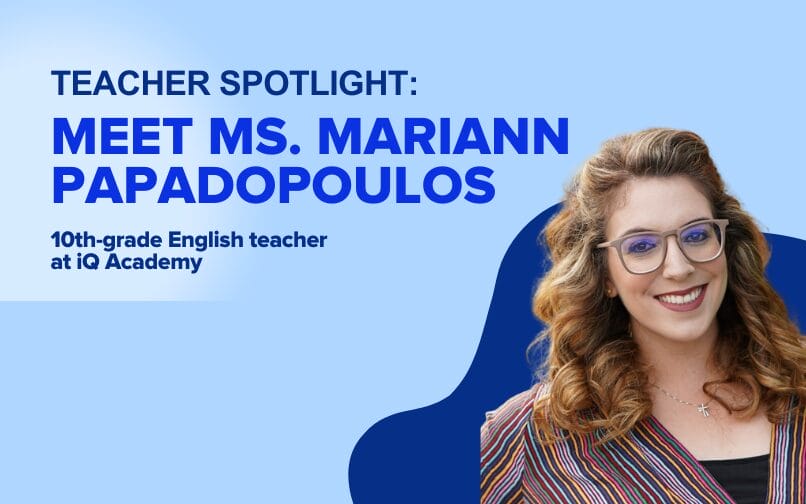
As a 10th-grade English teacher at iQ Academy, Ms. Mariann Papadopoulos knows that learning happens when students feel heard. With a background in English literature and theater, she brings creativity, discussion, and support into every lesson, helping students engage with classic texts and build real-world skills like critical thinking and communication.
Building a Space Where Students Feel Safe to Speak Up
Before joining iQ Academy, Ms. Papadopoulos spent five years teaching in a traditional classroom. Since moving to the online setting, she’s discovered how much students can grow when they’re given the space and encouragement to participate in their own way.
“There is a little bit more of that anonymity with the kids,” she explains. “We’re not face to face all the time, and I feel like it’s easier to create a safe space here between student and teacher.”
In her classroom, even students who start off hesitant often begin to engage over time; first by responding in a check-in or typing into a shared activity, then gradually speaking up and contributing to group discussions.
“I had a student who rarely participated in class but started answering questions just to me in the chat,” she said. “A few weeks later, he was responding so the whole class could see. It was so cool to go to his parents and say, ‘He’s opening up.’”
Bringing Literature to Life
Ms. Papadopoulos draws on her theater background to create lively, interactive lessons. Whether students are reading Macbeth or writing personal narratives, she uses gamified learning and collaborative discussions to bring texts off the page.
To keep students engaged, she incorporates games like Jeopardy and Kahoot into her lessons, allowing students to review material in a fun and competitive way.
When studying Macbeth, for example, she used a Jeopardy-style game to help students review key themes and characters while encouraging friendly competition.
She says her teaching style hasn’t changed much from in-person to online. “I’ve always been a big proponent of gamified learning, which is hands-on, and now I’m just doing that virtually.”
She believes that when students feel connected and invested in the material, they’re more likely to grow not just as learners, but as individuals.
Supporting Students Beyond the Lesson Plan
For Ms. Papadopoulos, academic success is only one part of a student’s journey. She often builds trust with students by creating an open, supportive classroom environment, including starting each class with emotional check-ins where students can share how they’re feeling.
“If I’m not feeling good, I’ll pick number nine,” she said, referring to a check-in activity with numbered emotion images. “And I’ll just say, ‘It was a tough morning, but we’re here.’” She finds that honesty helps students feel more comfortable opening up about their own challenges.
In one case, a student who was struggling with grades finally completed enough work to graduate. When he met her in person at graduation, he turned to her and said, “You saved me, you’re the reason I got to walk today.” That moment, she said, reminded her of the impact teachers have, even when it’s not immediately visible.
After that experience, she realized: “You don’t really know how much of an impact you’re making until something like that happens. And for students, just know we notice. Even the little things.”
Advice for iQ Academy Students
Ms. Papadopoulos encourages students to take their time finding their voice in the virtual classroom. She says even small steps like answering a check-in or sending a chat can lead to real confidence.
At iQ Academy, teachers like Ms. Papadopoulos prove that connection, creativity, and care are just as strong in virtual learning as they are in any brick-and-mortar classroom. Through thoughtful teaching and steady encouragement, she’s helping students find their voice one check-in, one conversation, and one breakthrough at a time.
Back to BlogRelated Blog Posts

Resources Available for Families Impacted by the Line Fire
Dear iQLA Families, In the wake of the recent Line Fire, we want to extend our […]
The Importance of Hispanic Teachers at iQLA
Hispanic educators play a critical role in shaping students’ futures, particularly at iQ Academy California, where […]

Supporting Student Mental Health
How iQ Academy’s Counselors Make a Difference The mental health challenges facing young people today are […]